
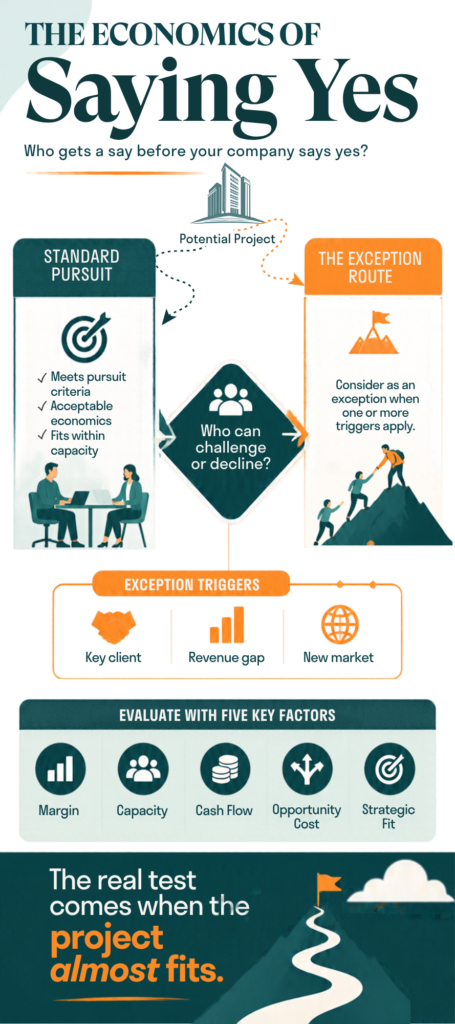
Who gets a say before your company says yes?
A strong backlog is, almost always, something to celebrate. The pipeline is active, clients are investing, and the business has work ahead. But a full backlog can create problems of its own, particularly when the work sold requires more capacity, coordination or leadership attention than the organization can reasonably support.
For construction and engineering firms, project selection is one of the clearest expressions of business strategy. It determines where the organization commits its people, capital and attention long before the financial results are known.
Experienced executives understand the economics. They know that contract value isn’t the same as profitability, that labor availability shapes delivery, and that some projects are better suited to the business than others.
The more interesting question is whether that understanding consistently influences the projects the company pursues.
When an attractive opportunity comes along, who gets to challenge the decision to say yes?
The people responsible for delivery need a voice before the commitment
FMI’s 2025 Project Management Study offers a compelling finding: construction firms involving project managers in estimating achieved profit targets 78% of the time, compared with 55% when project managers were excluded.
Based on responses and interviews with 243 construction executives and 84 project managers, the research points to a meaningful relationship between early delivery involvement and profit reliability. That makes sense when you consider how differently a project may look depending on who’s evaluating it.
Business development may see an opportunity to deepen an important client relationship or enter a new market. Finance may see an acceptable expected margin. Operations may see a project that depends on three people who are already committed elsewhere, or a schedule with little room for error.
Each perspective contributes something the others may not see. And each has implications for the economics of the project. The problem begins when the decision is made without adequately weighing those tradeoffs.
Growth ambitions are testing available capacity
The latest industry research makes this conversation especially relevant. Deltek’s 2026 Clarity Architecture & Engineering Study reported that firms were forecasting 9.5% net revenue growth while staff growth stood at just 1.2%. Median operating profit on net revenue had also declined to 16.7%.
The figures reflect an industry managing growth expectations alongside resource and profitability pressures. They don’t establish that companies are choosing the wrong projects, but they do reinforce the importance of how available capacity is allocated.
A project may meet its expected margin target and still be a poor use of the organization’s resources. It might require disproportionate attention from scarce technical specialists, prevent the company from pursuing stronger opportunities, or force senior leaders deeper into project delivery.
Those costs aren’t always obvious in the original pursuit discussion. They become apparent once the work is underway.
For executive teams, the decision is ultimately about which combination of projects the business can deliver profitably and consistently.
Change to Five Factors That Should Shape Project Selection Decisions
Most established project-based businesses already evaluate financial and operational considerations before pursuing work. The opportunity is to examine whether those considerations have enough influence when the project is large, the client relationship matters, or the pressure to add revenue increases.
1. Margin: What will we actually earn?
The expected contribution should reflect realistic delivery costs, complexity and risk. But will the team challenge an attractive revenue opportunity when the economics aren’t as strong as the contract value suggests?
2. Capacity: What will this work consume?
Having enough people to start the project is different from having the right capacity to deliver it well. Who can challenge the commitment if it stretches the people or capabilities the business depends on most?
3. Cash flow: When does the money arrive?
Billing milestones, payment terms and upfront delivery costs shape how much working capital the project requires. Are those implications fully considered before the business makes a commitment?
4. Opportunity cost: What might we have to turn down?
A profitable project may still be less attractive than other opportunities competing for the same resources. Does the team have enough visibility into what accepting this work could prevent it from pursuing?
5. Strategic fit: Does this advance where we’re going?
A project may strengthen a target market position, develop a capability or deepen an important relationship. But when exceptions become routine, the overall portfolio can begin to drift away from the strategy leadership has established.
These factors aren’t new. What matters is whether they consistently influence decisions and whether leaders are clear about the tradeoffs they’re accepting.
When the strategy changes but the pursuit decisions don’t
Consider a construction or engineering firm shifting toward larger, more complex projects.
Leadership agrees on the direction. Business development begins pursuing larger opportunities. Revenue potential increases, and the backlog starts to reflect the company’s growth ambition.
But the way the business operates may still be designed around a different kind of work.
A small group of experienced project leaders remains responsible for the most complicated delivery decisions. Estimating processes may not fully account for the additional coordination required. The CEO is still involved in resolving capacity conflicts. And project selection criteria may not have changed enough to reflect what the company can realistically support.
The firm may be winning exactly the kind of work its strategy calls for while struggling to deliver that work with its existing model.
The business has changed what it wants to sell without fully changing how it decides what it can deliver.
That is a leadership and execution challenge, with implications for project selection, accountability and how decisions are made across the organization.
The real test comes when a project almost fits
Most executive teams can describe the characteristics of a good project. The more revealing conversation happens when a desirable opportunity falls outside those criteria.
Perhaps it’s a major client asking for an exception. A contract that would close a revenue gap. A new-market opportunity with weaker near-term economics. Or a project the sales team is confident it can win, even though operations has serious concerns about the schedule.
There may be legitimate reasons to proceed. A lower-margin project could strengthen a valuable relationship or establish a credible position in a target market.
But who makes that call? And what information needs to be on the table before they do?
A strong pursuit process doesn’t eliminate exceptions. It makes them deliberate.
The executive team should know what it’s accepting, what the business may have to give up, and who is accountable for the decision.
Otherwise, individual opportunities can gradually begin determining the direction of the company.
Four questions worth bringing to your executive team
1. Who gets a voice before we commit? Does operations participate early enough to influence the pursuit, or does it primarily inherit responsibility for delivery after the decision has been made?
2. What are we willing to say no to? Are our pursuit criteria strong enough to hold when a major client or revenue target creates pressure to make an exception?
3. Do we understand the economics across the portfolio? Can we compare work based on contribution, capacity, cash requirements and strategic value, rather than looking at projects in isolation?
4. Who owns the tradeoffs? When commercial, financial and operating priorities compete, is it clear who can approve an exception, change the terms or decline the work?
The goal isn’t to elevate every project decision to the executive team. It’s to establish a shared approach that allows leaders to make good decisions consistently and bring forward the exceptions that deserve greater scrutiny.
A better backlog starts with better decisions
Winning work will always matter. But the ability to deliver that work profitably, protect critical capacity and advance the company’s strategy matters just as much.
A better pursuit process starts with understanding the full economics of an opportunity, bringing the right perspectives into the conversation and giving those perspectives meaningful influence over the outcome.
The next important question may not be whether your company can win the project. It’s whether the organization should commit to delivering it, and who gets to make that call.
Industry research
- FMI, Why Project Management Still Fails: 2025 Project Management Study, Part 1 (October 2025). https://fmicorp.com/insights/thought-leadership/2025-project-management-study-part-1
- Deltek, 47th Annual Clarity Architecture & Engineering Industry Study (2026). https://info.deltek.com/Clarity-AE
- Research interpretation: The FMI finding reflects an observed association between project-manager involvement in estimating and achievement of profit targets. Deltek’s figures are A&E industry benchmarks, not evidence that pursuit decisions caused the reported capacity or profitability pressures.